
EM-FIBERGLAS A/S
Laminating
Advanced Fiberglass Laminating Solutions
At EM Fiberglas, laminating is at the core of our composite manufacturing process. Using proven fiberglass techniques combined with skilled craftsmanship, we produce durable, lightweight, and dimensionally stable composite components for a wide range of industries.
Our production setup allows us to manufacture both small and large series while maintaining consistent quality throughout the entire process.
Tailored Lamination Methods
Different applications require different manufacturing approaches. We select the most suitable laminating method based on geometry, strength requirements, surface finish, and production volume.
Hand Laminating
Hand laminating is a flexible manufacturing method ideal for complex geometries, customized parts, and lower production volumes.
The process begins with preparation of the mold surface and application of gelcoat to create the desired finish and protection. Layers of fiberglass reinforcement are then carefully placed and saturated with resin to build the required strength and stiffness.
This method provides excellent control of laminate thickness and allows reinforcement materials, inserts, or core materials to be integrated directly into the component during production.
Benefits of hand laminating include:
- High flexibility in design and geometry
- Strong and lightweight constructions
- Controlled laminate build-up
- Suitable for prototypes and smaller production runs
- Possibility for integrated reinforcements and inserts

Wet pressing
With wet pressing the glass fibres are laid in a mould and saturated with fluid resin. The mould is usually heated up to optimise the process before sealing with a hydraulic press. When hardened, the mould is opened and the product ejected.
EM Fibreglass’s use of wet pressing includes the manufacture of meter boxes. The process is also used for equipment for the healthcare sector.
This process is used for relatively large batches. In terms of process equipment, it is a comparatively expensive investment.
The benefits of wet pressing:
- Short process time
- Even quality
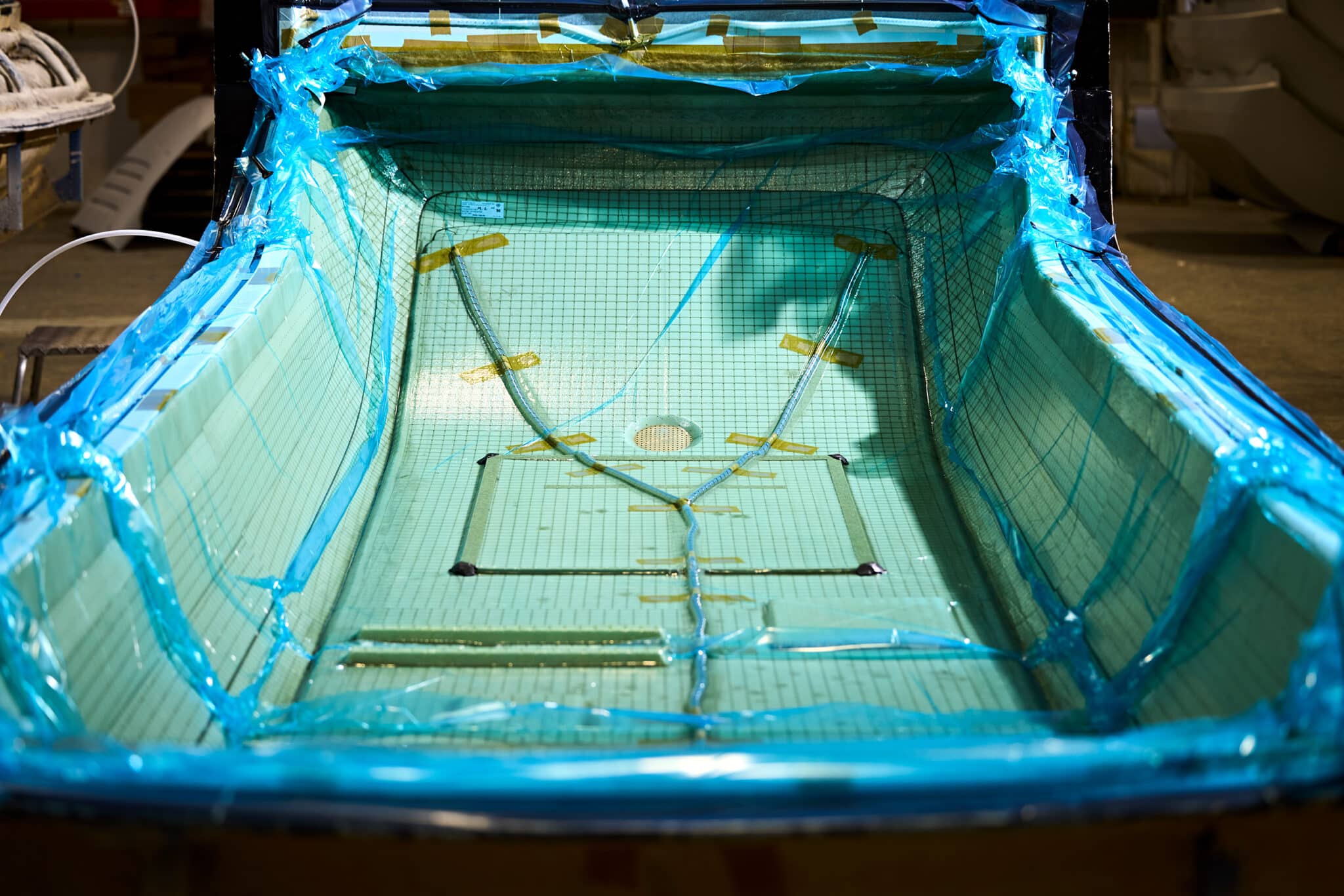
Resin Infusion Molding (RIM)
Resin Infusion Molding is an advanced closed-mould manufacturing process used to produce lightweight and high-strength composite components with excellent consistency.
In this process, dry fiberglass reinforcements are placed into the mold before being sealed under vacuum. Resin is then drawn through the laminate using controlled vacuum pressure, ensuring complete wet-out of the reinforcement materials while minimizing excess resin usage.
The result is a highly controlled laminate structure with improved mechanical performance, reduced weight, and a cleaner production environment compared to traditional open mold methods.
RIM is particularly suitable for applications where strength-to-weight ratio, surface quality, and repeatability are important.
Advantages of Resin Infusion Molding include:
- High fiber-to-resin ratio
- Lightweight and strong constructions
- Consistent laminate quality
- Reduced emissions during production
- Excellent surface finish possibilities
- Suitable for medium to large composite components
This process is widely used for technical and structural composite parts across industrial, marine, transportation, and construction applications.
Resin Transfer Molding (RTM)
Resin Transfer Molding is a closed-mould production method designed for precise and repeatable manufacturing of composite components.
During the process, dry reinforcement materials are positioned inside a matched mold system. Resin is then injected under pressure into the closed mold cavity, where it fully impregnates the fiberglass reinforcement before curing into the final component shape.
RTM enables accurate control of component dimensions, laminate structure, and surface finish on both sides of the part. The process is highly suitable for serial production where consistency, efficiency, and high-quality surfaces are required.
Typical benefits of RTM include:
- Excellent dimensional accuracy
- Smooth surface finish on both sides
- High repeatability for serial production
- Reduced post-processing requirements
- Efficient production cycles
- Integration of inserts and core materials
Resin Transfer Molding is often selected for technically demanding components where precision and production efficiency are essential.
Integrated Features and Reinforcements
During the laminating process, additional elements can be incorporated directly into the part construction. Depending on the application, components may include:
- Structural reinforcements
- Foam cores for increased stiffness
- Metal inserts and fixing points
- Thermal or acoustic insulation layers
- Mounting brackets and integrated supports
This integrated approach reduces assembly time and improves overall product performance.